
Torquey time traveller
Submitted by:
Alvis is reawakening its pre-War engine components for its brand new Continuation Series cars
In a quiet corner of Kenilworth, Warwickshire, a team of engineers is doing something few others would dare to attempt: routinely breathing new life into engines that have lain still since the 1960s. Reviving an engine dormant for decades can present a considerable challenge to even an experienced mechanic, so it’s an ambitious endeavour to integrate the restoration of engine blocks that predate the split of The Beatles into your business model. Enter The Alvis Car Company and its Continuation Series of pre- and post-war luxury cars, a project that doesn’t just recreate the past but rejuvenates it with mechanical authenticity and modern-day precision.
For its post-war Continuation models, Alvis enjoys a unique advantage: a treasure trove of new old stock, with over 250,000 parts, including original blocks and cylinder head castings in pristine condition. Untouched for more than 50 years, these were the final engine parts Alvis manufactured before ceasing automobile production in 1967 at the original Coventry factory and many are used directly in the assembly of Alvis’ 3.0-litre, six-cylinder Continuation Series engines.
Before these castings are granted a new lease of life, each one undergoes thorough scrutiny: a visual inspection, crack and pressure testing for coolant integrity and precise dimensional examination. Only components that pass are taken forward and assembled to modern tolerances and standards. Though technically ‘new’ and unused, these parts are held to the standards for assessing any used or salvaged component.
Other internals, such as conrods, camshafts and pistons, also come from Alvis’ extensive inventory, which already supports a global network of over 4500 Alvis cars still on the road. Some are original stock, while others have been remanufactured by reverse engineering existing parts, using an enormous archive of 25,000 drawings and diagrams. This careful balance between old and new, alongside rigorous testing and a blend of traditional and modern techniques, promises Alvis owners a unique blend of originality and reliability.
The pre-war Continuation Series engines require a different strategy. For Alvis’ famous 4.3-litre, six-cylinder engine, limited old stock means the company relies on its reverse engineering process, aided by approximately 25,000 pre-war blueprints and drawings. Components such as the crankcase, cylinder block and cylinder head are all modelled and machined in-house. While the engines retain their original architecture, they are subtly re-engineered to accommodate modern fuels and emissions requirements, including a catalytic converter. The original SU carburettors are replaced with throttle bodies that mimic their appearance but are controlled by a modern engine management system, allowing for precise fuelling and ignition control. This improves drivability and reliability without sacrificing character.
Engines are assembled by hand and extensively tested on a rolling road. The result is an engine that looks, sounds and feels true to its 1930s counterpart.
Despite their historical fidelity, these powertrains are built to start on the button, be driven eagerly and comply with modern emissions standards. This includes the integration of electronic management and tighter machining tolerances, with engines fully mappable for finely tuned performance and efficiency. Running a catalytic converter was a non-negotiable but required precise control of the air-to-fuel ratio, forcing a switch to closed-loop fuel injection. While not designed with increased power in mind, improvements in drivability, economy and emissions are natural benefits of using modern materials and systems, yielding a more refined yet period-correct engine. Interestingly, when the project was first evaluated, the combustion chamber design already offered a cleaner burn, underlining how advanced and well-engineered the cars were in period.
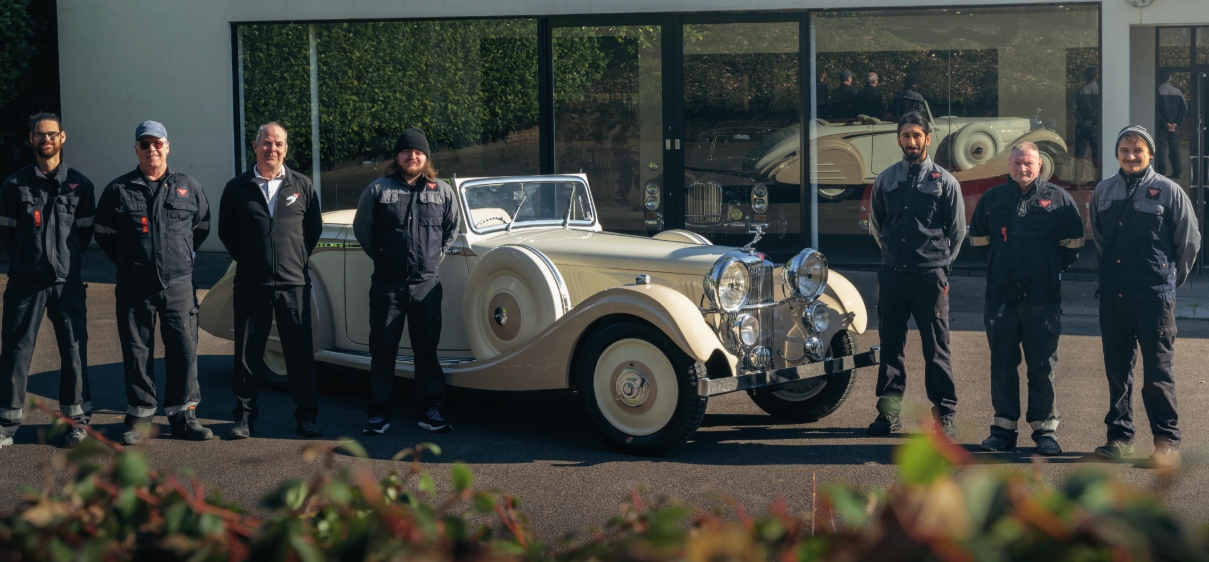
Each Continuation car takes around two years to complete, with over 3,800 hours invested in some models. Assembly is handled by a team blending traditional craftsmanship with modern engineering. Keen to keep the passion and expertise alive, Alvis actively mentors young engineers alongside experienced team members, preserving and passing on these rare skills for future generations.
Prices for Alvis Continuation Series cars start at £325,000 and every model comes with a three-year warranty, including coverage of the hand-built engine. After-sales servicing support is expertly handled by Alvis’ sister company, Red Triangle, the authentic home of Alvis spares, repairs and servicing.
What truly sets these engines apart is their individuality, especially in the pre-war models, where no two are exactly alike. The marque’s engineering and innovation were world-class in-period and Alvis embodies this spirit as an ambitious engineering company to this day. The solutions devised in the 1930s and 1940s were clever, elegant and frequently ahead of their time. Recreating these engines is not simply a technical achievement, it’s a tribute to the ingenuity of British engineering. These engines may have started life in another century, but thanks to Alvis, they’re not retired yet.