
Let’s go round again
Submitted by:
Only Mazda has ever committed to the rotary engine with any conviction. As a result, this quirky motor has gained a small and cult-like following. But now it has a new life, one that’s perfectly aligned with current attitudes and legislation. Is it time for the Wankel rotary to go mainstream?
Should we admire Mazda for its continued use of the rotary engine? Or is adding it to regular passenger cars, performance cars, turbocharging it, racing with it all the literal definition of insanity, ‘doing the same thing over and over and expecting different results’? Mazda has now added another use to its rotary motor, that of an electric generator. Given that no one else has adopted the technology, is this bold or bonkers?
The origin of the rotary can be traced back to 1951 when an engineer working for NSU Motorenwerke, Felix Wankel, started to develop a whole new type of internal combustion engine. NSU would later be acquired by the Volkswagen group and merged with Auto Union to create Audi.
At the Heart of Wankel’s rotary engine is a triangular rotor that spins in a bean-shaped housing; the apex tips of the triangle seal with the wall of the housing. The cavities between the rotor and the housing are where the different sequences of the combustion process take place. As a result, no valves are needed; holes in specific places in the housing or sides allow air and fuel in. As the rotor spins, it shifts the air with it and compresses it before it's ignited by a spark plug mounted further around the housing. The rotor then moves the exhaust gases out of another hole. One of the major benefits of the Wankel design is that there are essentially three active combustion chambers all acting simultaneously. This makes the power output of a Wankel rotary comparatively high, considering capacity and revs.
The Wankel rotary engine was first put to use in aircraft, and the design piqued Mazda’s interest. The Japanese company signed a deal with NSU to develop its own version of the engine. In the early 1960s, Mazda created the Rotary Engine Development Centre. Kenichi Yamamoto, who had originally worked on Mazda’s transmission production line and would later become president of the whole company, led a team of 47 engineers to work on the rotary project. Mazda would compete with the Germans to see who could bring a rotary-powered production car to market first. NSU won, and in 1964 the Spider was launched. Three years later, the NSU Ro80 made an appearance. Sadly, the NSU’s Wankel engine suffered from serious apex seal wear and therefore engine failure. The warranty costs that NSU had to uphold stifled its development of the rotary.
Mazda’s version of the Wankel’s concept didn’t suffer from early apex seal wear. To prove it, Mazda entered its first rotary-powered car, the Cosmo, in the gruelling Marathon de la Route, which by then was held at the Nürburgring over a non-stop 82-hour period. The Mazda finished the event, narrowly missing the podium and finished fourth.
Mazda used its rotary technology in all sorts of vehicles, such as buses and pickups. However, it’s rotary-powered performance and racecars that we really remember. It’s the RX-7, the company’s flagship sports car, that’s most famous for its rotary engine. From 1978 to 2002, over three generations – some with turbochargers – Mazda built the RX-7 with the two-rotor Wankel-inspired 13B engine. The coupé also proved itself as a very capable competition car, winning endurance races including the 24 Hours of Daytona and Spa 24 Hours, and championships such as the British Touring Car Championship and Australian Endurance Championship. It also held its own as a rear-wheel drive car amongst a field of four-wheel drive monsters in the Group B rally era.
The rotary had its day at the top echelons of motorsport, too. Mazda’s Eighties prototype campaign at Le Mans culminated in 1991 with the 787B, with its four-rotor engine with variable inlets and 700hp. The 787B took overall victory before Wankel-engined cars were outlawed in the race.
The final rotary-powered Mazda was the RX-8 – a four-door coupé with a redesigned rotary motor. Related to the 13b in the RX-7, this new engine had relocated exhaust ports and revised apex seals. It was not only much more efficient than the RX-7’s engine, but it also produced 235hp without the use of any turbochargers – not wildly behind the 265hp of the forced induction 13B in the later RX-7.
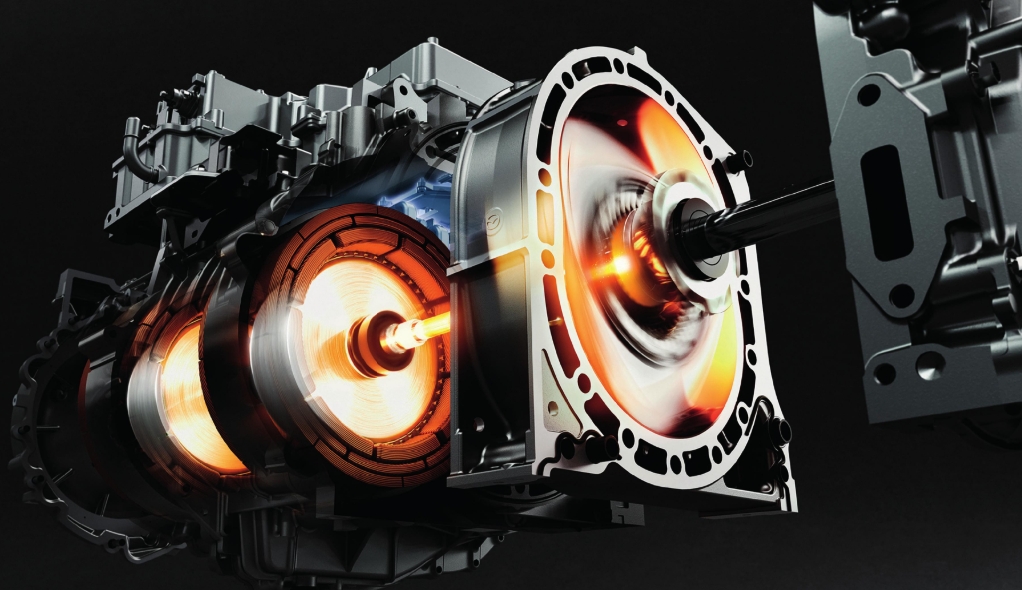
Calling the RX-8 the ‘final rotary-powered Mazda’ is only correct on a technicality. That’s because Mazda has reinvented the Wankel engine for a different use. In the MX-30 e-Skyactiv R-EV, Mazda has added an 830cc single-rotor petrol engine onto the SUV’s electric motor to make it a hybrid vehicle. Unlike a conventional hybrid, however, when a car can drive using the electric or internal combustion engine, the MX-30 is always driven by the electric motor. Despite being positioned next to the electric motor, the rotary engine only acts as a range extender, a generator to top up the battery. The close proximity is so that the electric motor can be used to spin up the rotary motor; there is no permanent physical way for the internal combustion engine to drive the gearbox and wheels.
It seems a waste to use such an unusual engine, one so exotic and different, one synonymous with sports and racecars, as a measly generator. But there are numerous ways that a Wankel engine is actually perfectly suited for such a job.
The first is size. The rotor in the MX-30 hybrid is just 76mm wide – and with a single-rotor engine, that’s practically the entire length of the engine. Despite its extremely compact size, it boasts an 830cc capacity with an output of 75hp. Mazda has also used aluminium side housings, sprayed with a ceramic coating, instead of the steel ones used in its previous Wankel engines to reduce weight.
Small and light engines make fewer vibrations, and rotary engines are already some of the smoothest internal combustion engines. Quite often, they are quieter too – when they’ve not been tuned for high horsepower applications. So, as an engine to purr away as stealthily as possible, a rotary engine makes a lot of sense.
One of the downsides of a rotary engine is that you cannot employ variable valve timing to improve power or efficiency, as there are no valves. But a generator only needs to work at one rpm, so you can take advantage of its size, weight and smooth running and still make it incredibly efficient.
To maximise that efficiency, Mazda has patented a system that uses the drag and boost of an electric motor to influence the revs of a rotary engine, so they change faster than just throttle application, to keep the motor operating at its most efficient rpm. Mazda hasn’t officially said if this technique is employed by the MX-30 hybrid, but the car has all of the elements required.
For anyone who idolises the Wankel because of the RX-7’s plucky race victories, the way the 787Bs howled down the Mulsanne straight or just the hunting, rasping noise that a highly tuned rotary makes when it idles, the idea of this quirky engine being used as a side note to an electric motor will be almost painful. For these people, the undignified life of a generator is not what a rotary is for; the Wankel should have died with the RX-8 and its head held high. But like it or not, the rotary has found a new life. It might not be glamorous or fast, but it’s a life that’s very good at.